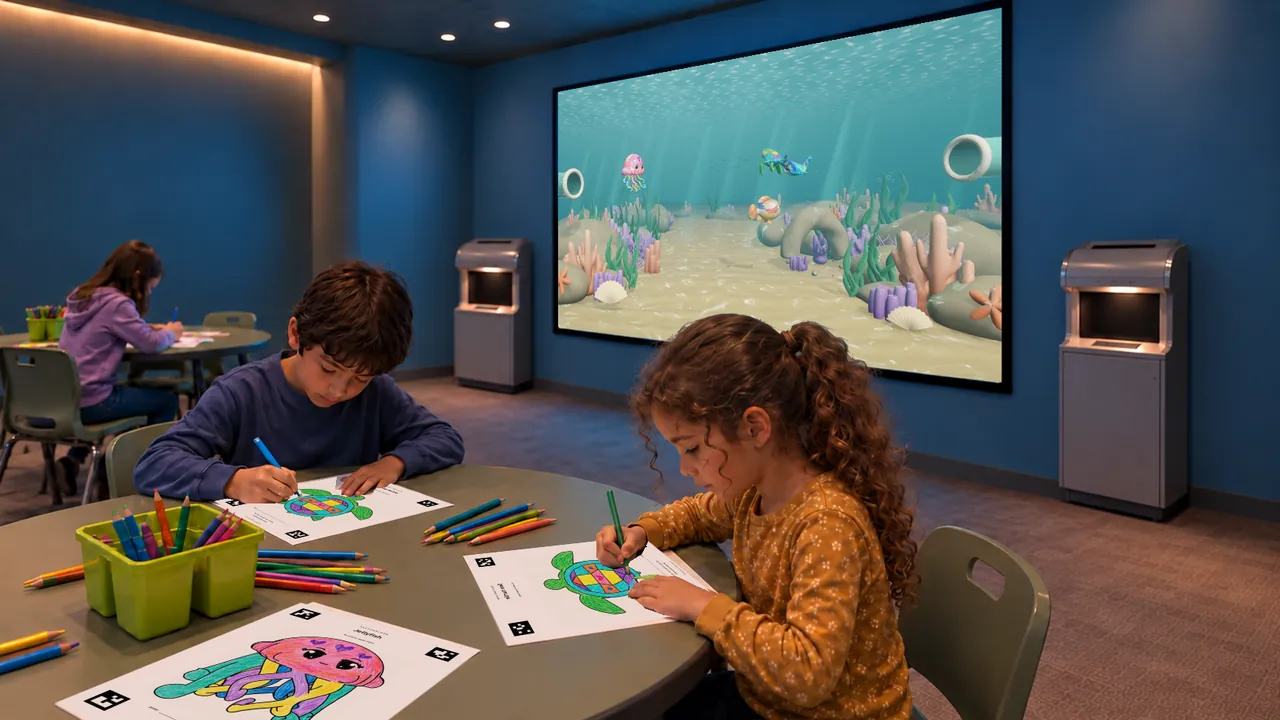
We design our digital exhibits around the actions visitors take and the way your team will operate the space. A drawing becomes more interesting to follow when visitors can recognize what happened to their own marks. A pattern built from physical pieces can make an animated response feel connected to something they did. When planning a creative exhibit zone, look closely at that connection. The transition from making to seeing should be understandable, and the visitor’s contribution should remain part of the story.
Choose the kind of making you want to offer
Paper coloring, arranging blocks, drawing on glass and moving a spray controller are different activities. They use different gestures and leave different kinds of results. Choose the process before deciding how large the screen should be.
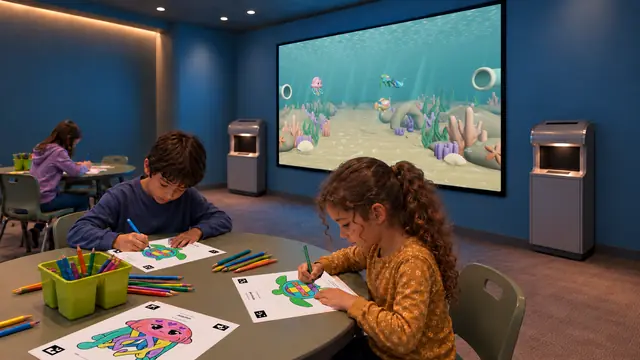
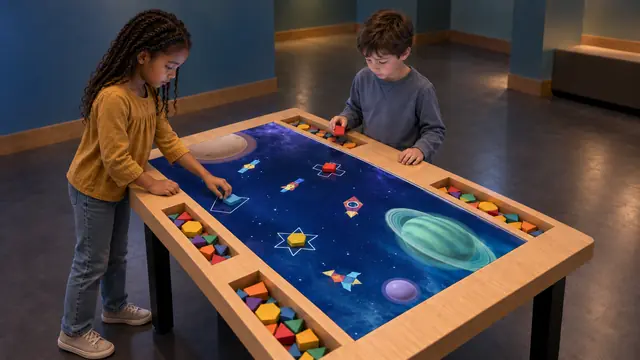
Sketch Bloom begins with approved printed character outlines. The colored paper passes through a scanning step before the character appears in a shared environment. Build Bloom keeps the physical pieces and digital scene together on a table. One experience has a journey between stations; the other concentrates making and feedback in the same place. Their furniture and staffing plans should reflect that difference.
Make the connection visible
Walk through the activity from the visitor’s position. Can they identify their contribution in the result? Is there time and space to compare it with what they made? At a coloring wall, avoid placing the scanner where a child must immediately move out of view of the main display. At a building table, consider whether a companion can see both the arrangement and its response.
The broader idea of physical material paired with a responsive digital representation is also demonstrated by the UC Davis AR Sandbox research: shaped sand is augmented with terrain colors, contours and simulated water. This is a reference for the interaction approach, not a claim that every commercial installation uses identical hardware or software. UC Davis project overview.
Give each creative tool its own purpose
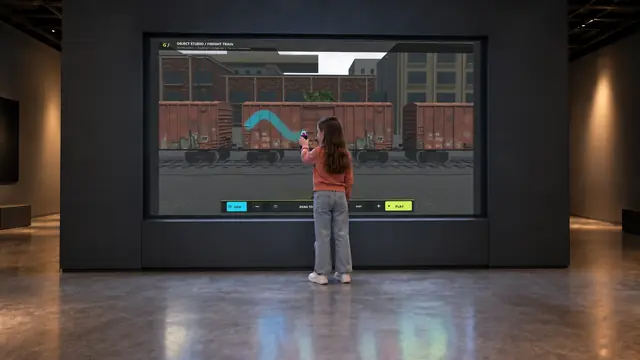
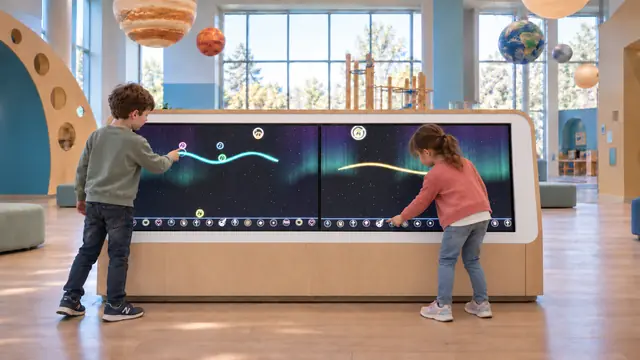
Digital Graffiti offers a large canvas controlled through a digital spray device, with wall and vehicle scenes. Sketch Music connects direct touch drawing with a responding visual and musical world. These can sit within one creative program, but they should not be described as interchangeable drawing screens.
A useful program might invite visitors to compare making a broad spray mark with arranging a precise geometric edge, or to listen after changing a drawing. Keep such prompts open enough for different results. Confirm the delivered tool behavior before writing activity instructions, especially where the demonstration does not explain exactly how a particular mark affects sound or animation.
Explain AI as interpretation
AI Painter introduces another relationship: a visitor sketches on a kiosk while a larger display presents generated artwork. Ask visitors to compare the sketch and the result. What stayed recognizable? What did the system add? What changes when the visitor revises a line or color?
Avoid presenting the output as a faithful reproduction of the drawing. The exhibit is an opportunity to discuss interpretation and creative choices. Before commissioning, establish the processing arrangement, internet dependency, licensing and any retention or sharing of visitor inputs. These are scope questions for the supplied system, not assumptions to make from the appearance of its interface.
Design the room around the process
Creative zones need places for materials as well as screens. Plan paper storage, coloring tools, approved templates, piece trays and controller storage according to the selected activities. Allow useful task lighting without creating reflections or weakening projected images. Keep circulation clear when a visitor pauses to show a companion their work.
Finish the brief with a sample visitor sequence for each exhibit and a staff reset sequence between users. That makes the creative promise practical: visitors can make a recognizable contribution, understand the response and find a reason to try a different choice.